sacred mountain Henan
Mount Song (Zhongyue)
The Central Peak and Zhongyue Temple
World Heritage Site (2010) — "Historic Monuments of Dengfeng in 'The Centre of Heaven and Earth'", a serial listing that includes Zhongyue Temple and the Han-dynasty Taishi Que gate-towers
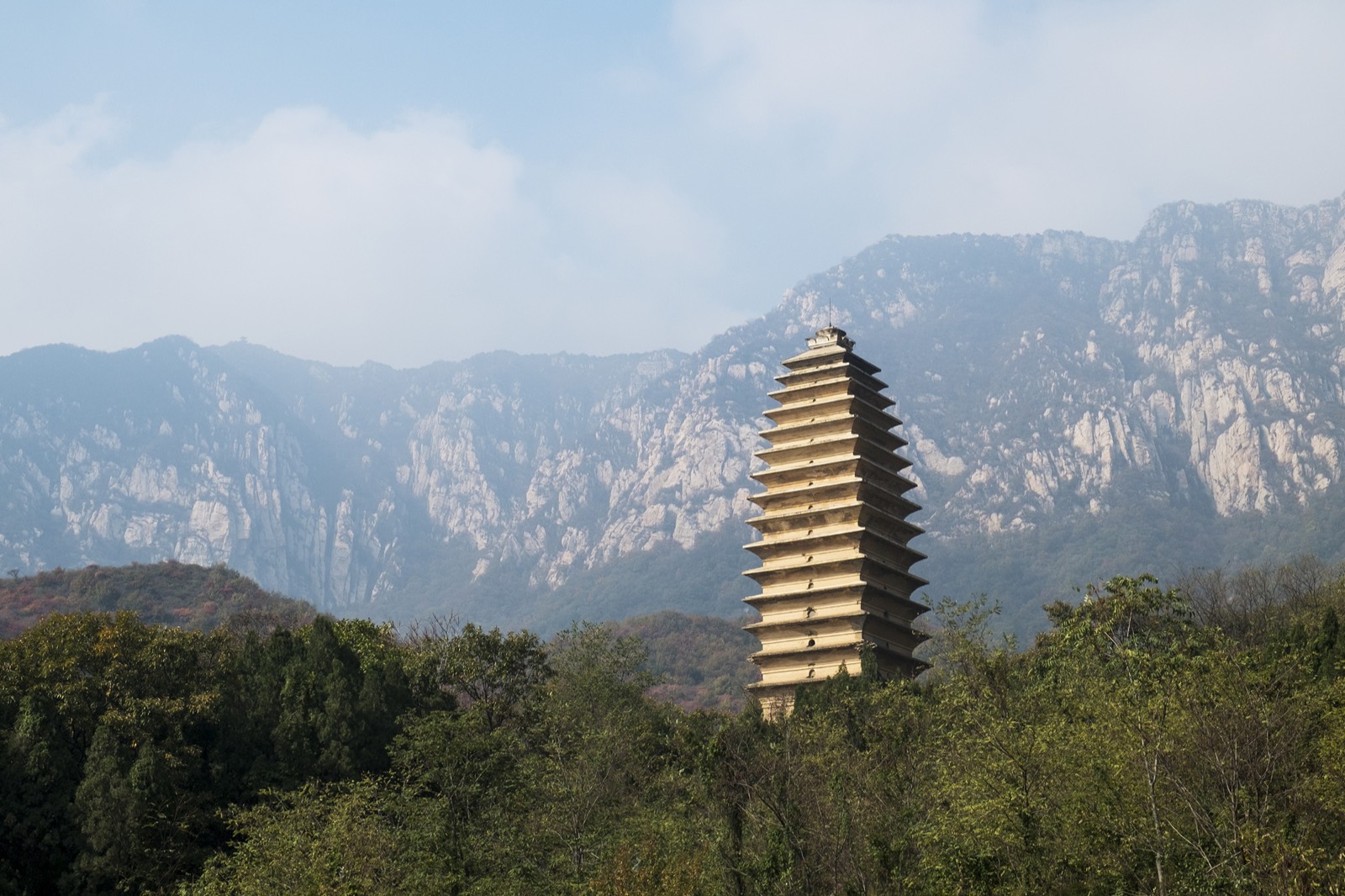
The Central Peak (Zhongyue) of the Five Great Mountains. Mount Song is widely known outside China chiefly for Shaolin Temple, a Buddhist institution on its slopes — but the mountain's Taoist heart is Zhongyue Miao (Zhongyue Temple), near the town of Dengfeng, one of the oldest and largest Taoist temple complexes in the country, laid out in a design that consciously echoes the imperial palace architecture of the Forbidden City. Just outside the temple stand the Taishi Que, a pair of stone gate-towers erected in 118 CE, among the oldest surviving stone architecture in China.
Sacred narrative
Empress Wu Zetian's ascent and the naming of Dengfeng
In 696 CE, Empress Wu Zetian — the only woman to reign as sovereign empress in Chinese imperial history — travelled to Mount Song and performed a sacrifice modelled on the feng and shan rites more commonly associated with Mount Tai, a striking claim of legitimacy for a ruler whose path to the throne had broken every convention of succession. To mark the event she renamed the adjoining county Dengfeng, "ascending to the summit," a name the town still carries. Zhongyue Miao itself, the Central Peak's state temple, predates her visit by centuries and continued to be expanded long after it, but the episode remains the mountain's best-documented moment of direct imperial engagement, and a reminder that Mount Song's Taoist identity as Zhongyue is distinct from — and considerably older than — the Buddhist Shaolin tradition that shares its slopes.
History
Founded Sacrificial shrine since the Qin dynasty; Taishi Que gate-towers erected 118 CE; Zhongyue Miao's present palace-style layout dates substantially to Qing-dynasty reconstruction.
Key figures
- Emperor Wu of Han (early imperial patronage)
- Empress Wu Zetian (696 CE ascent and sacrifice at Mount Song)
Major events
- Qin dynasty: earliest recorded shrine to the God of the Central Peak
- 118 CE: Taishi Que stone gate-towers erected near the temple site
- 696 CE: Empress Wu Zetian ascends Mount Song and performs a feng-style sacrifice, renaming the adjacent county Dengfeng ("ascending to the summit") in commemoration
- Qing dynasty: Zhongyue Miao rebuilt in its present palace-style layout
- 2010: UNESCO World Heritage inscription as part of the "Historic Monuments of Dengfeng" serial listing
Today
The site as it currently stands.
Road access from Dengfeng town; Zhongyue Miao and the Shaolin Temple area are separately ticketed within the wider scenic zone
April–June and September–November
Dengfeng, Henan; Zhengzhou (nearest major airport)
Active Taoist clergy resident at Zhongyue Miao
busy
Back to the geography
Return to Sacred sites, or read the concepts practised there.