high deity The north; martial protection; exorcism of demons
Zhenwu (Xuanwu)
A renunciate-prince deity of the north, associated with the turtle and snake, whose cult centers on Mount Wudang and who was adopted as the Ming imperial house's protector deity.
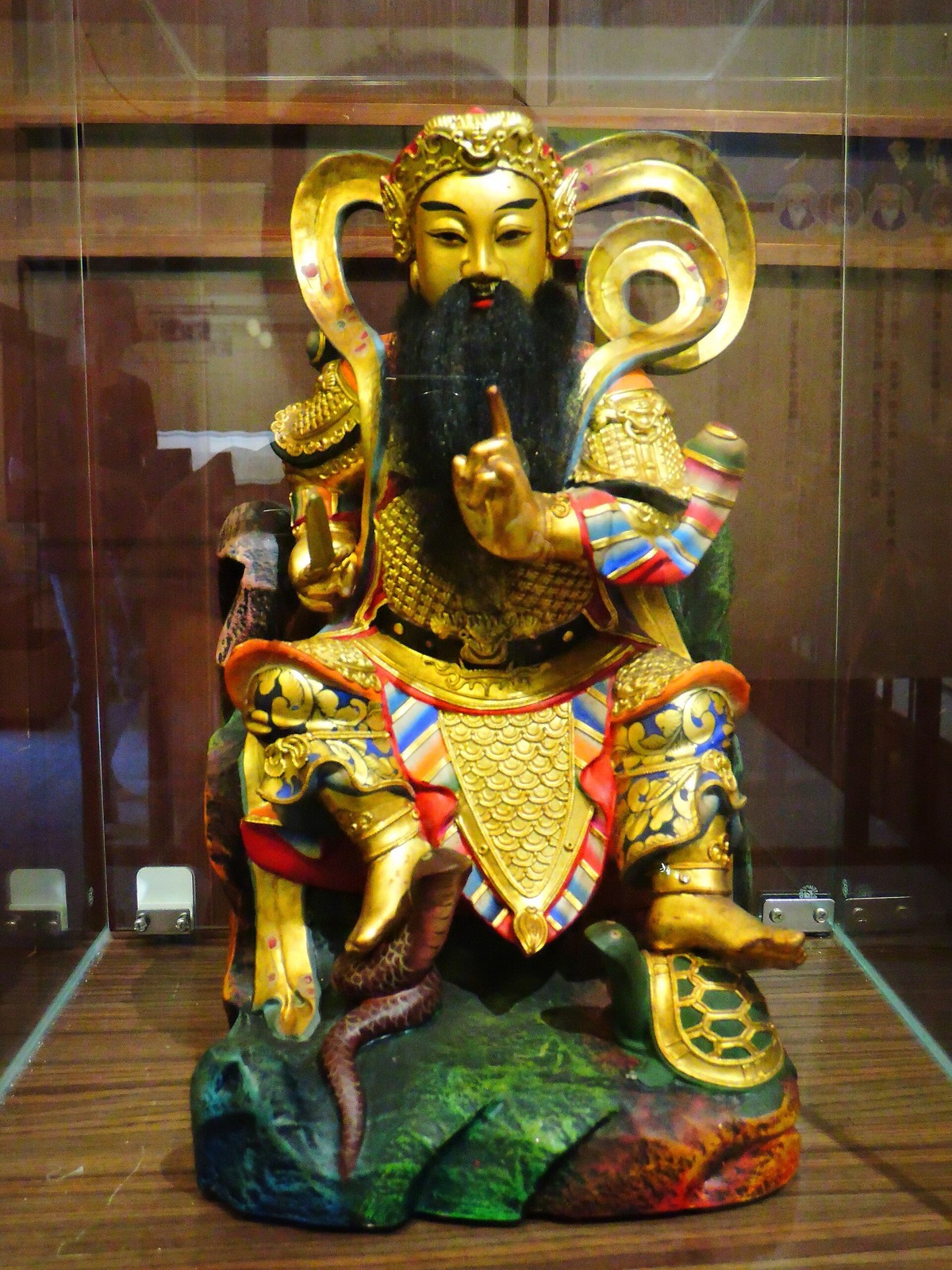
Zhenwu's core story is a renunciation myth: a prince who gave up succession to a throne to seek the Dao, retreating to Mount Wudang, where he is said to have cultivated for forty-two years — sustained, in some tellings, only by his resolve — until he achieved immortality and ascended into the sky from the mountain's summit peak. He is depicted barefoot, armed, standing or seated with a black tortoise entwined by a snake beneath his feet, an image tied to the ancient Chinese association of the north with winter, water, and the tortoise-and-snake constellation of the "Black Tortoise" — one of the four cardinal-direction guardian beasts of Chinese cosmology.
His cult expanded enormously under the Ming dynasty. The Yongle Emperor, who had seized the throne through civil war, credited Zhenwu with supernatural aid in his campaigns and, upon taking power, rebuilt Mount Wudang into a vast imperial-scale temple complex as an act of state devotion — the single largest sacred-site construction project of the era. Zhenwu is venerated today as a martial protector against chaos and demonic forces, and Wudang remains both his primary cult center and, not coincidentally, the historical cradle of Taoist internal martial arts, which are understood as an embodied expression of the same cosmological mastery Zhenwu himself achieved.
Iconography
A barefoot armored warrior, standing on a black tortoise entwined with a snake, often holding a sword
Epithet
The Perfected Warrior
Festival: 3rd day of the 3rd lunar month (his traditional birthday)
Enshrined at
Where to find this figure.
Back to the pantheon
Return to Pantheon, or read the concepts behind these figures.