sacred mountain Hubei
Mount Wudang
The mountain of the Perfected Warrior
World Heritage Site (1994) — "Ancient Building Complex in the Wudang Mountains"
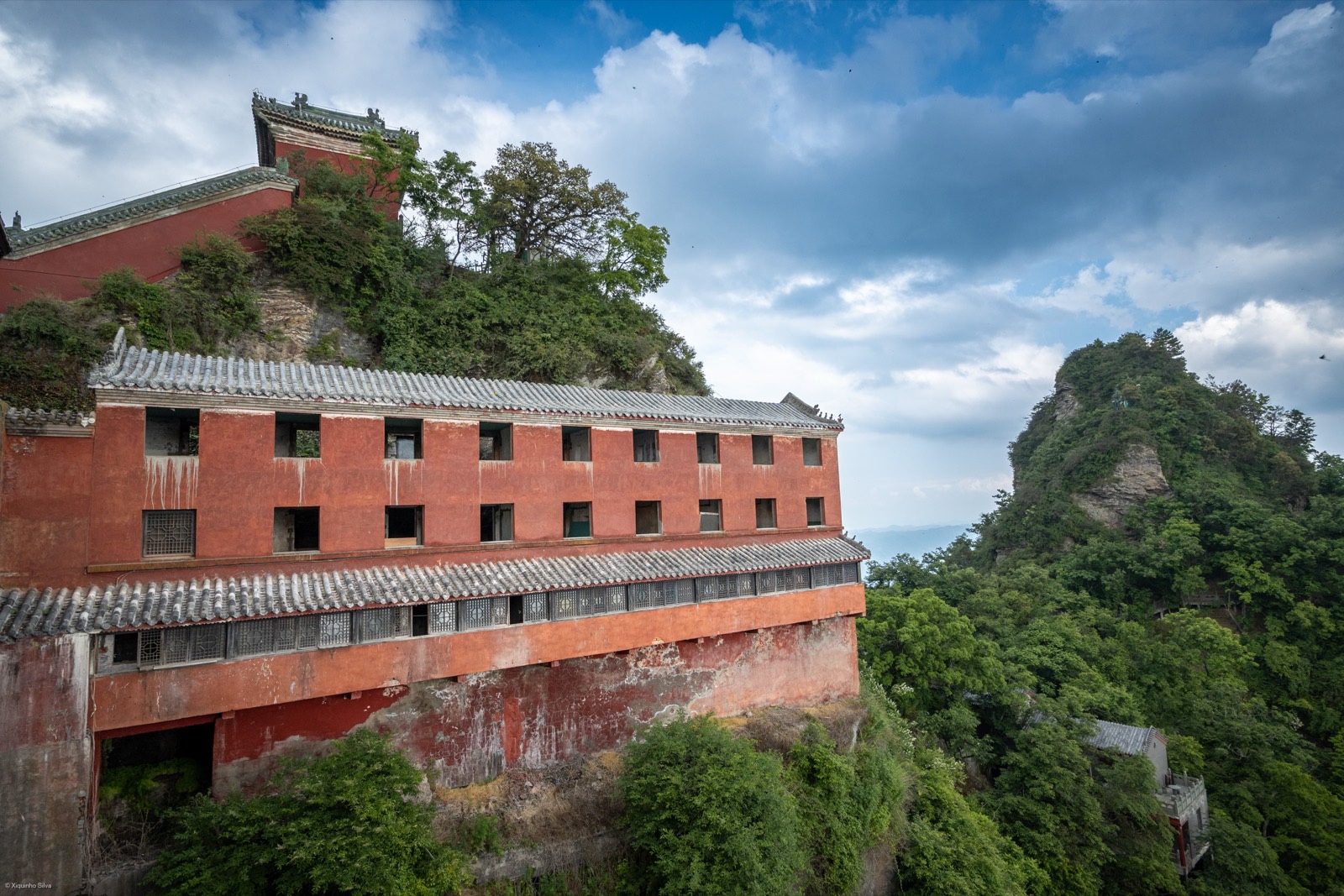
The most important Taoist mountain in China after the tradition's founding sites, and the ceremonial seat of the cult of Zhenwu (the Perfected Warrior, also called Xuanwu). Ming dynasty emperor Yongle rebuilt the mountain into an imperial-scale complex of over thirty temple groups between 1412 and 1424, claiming Zhenwu as his dynasty's protector deity. Wudang is also the traditional birthplace of internal martial arts (neijia quan), most famously taijiquan, taught here as a physical expression of Taoist cosmology rather than as combat sport.
Sacred narrative
The ascent and apotheosis of Zhenwu
The core myth of Wudang is the story of Zhenwu (the "Perfected Warrior," also Xuanwu, the "Mysterious Warrior"). As a prince who renounced the throne, he came to Wudang to cultivate the Dao, meditating for forty-two years until he achieved immortality and ascended to heaven from the mountain's summit — the Heavenly Pillar Peak, where the Golden Hall now stands. He is depicted as a barefoot warrior seated with a snake and turtle beneath his feet, a symbol of mastery over the northern direction and over chaos itself. The Ming dynasty adopted Zhenwu as the imperial house's protector after Yongle credited the deity with his own military success, and rebuilt the mountain accordingly — the largest state investment in a single sacred site in Chinese history at the time.
History
Founded Temple presence from the Tang dynasty (7th century); imperial-scale rebuilding under the Yongle Emperor, 1412–1424.
Key figures
- Zhang Sanfeng (semi-legendary founder of Wudang internal martial arts)
- Yongle Emperor (Ming dynasty patron)
Major events
- Tang dynasty: earliest recorded Taoist structures
- 1412–1424: Yongle Emperor commissions a 30-temple imperial complex, staffed by an estimated 8,000 workers
- 1994: UNESCO World Heritage inscription
- Ongoing: Wudang remains an active Quanzhen monastic community and international martial-arts pilgrimage site
Today
The site as it currently stands.
Cable car and hiking trails from Wudangshan town; the summit Golden Hall requires a final steep ascent on foot
April–June and September–November
Shiyan, Hubei (nearest airport); Wuhan (major hub, ~4hr by road/rail)
Resident Quanzhen monastic community; internationally known martial-arts academies operate on and around the mountain
busy
Back to the geography
Return to Sacred sites, or read the concepts practised there.