city temple Sichuan
Qingyang Gong
The Green Ram Temple of Chengdu
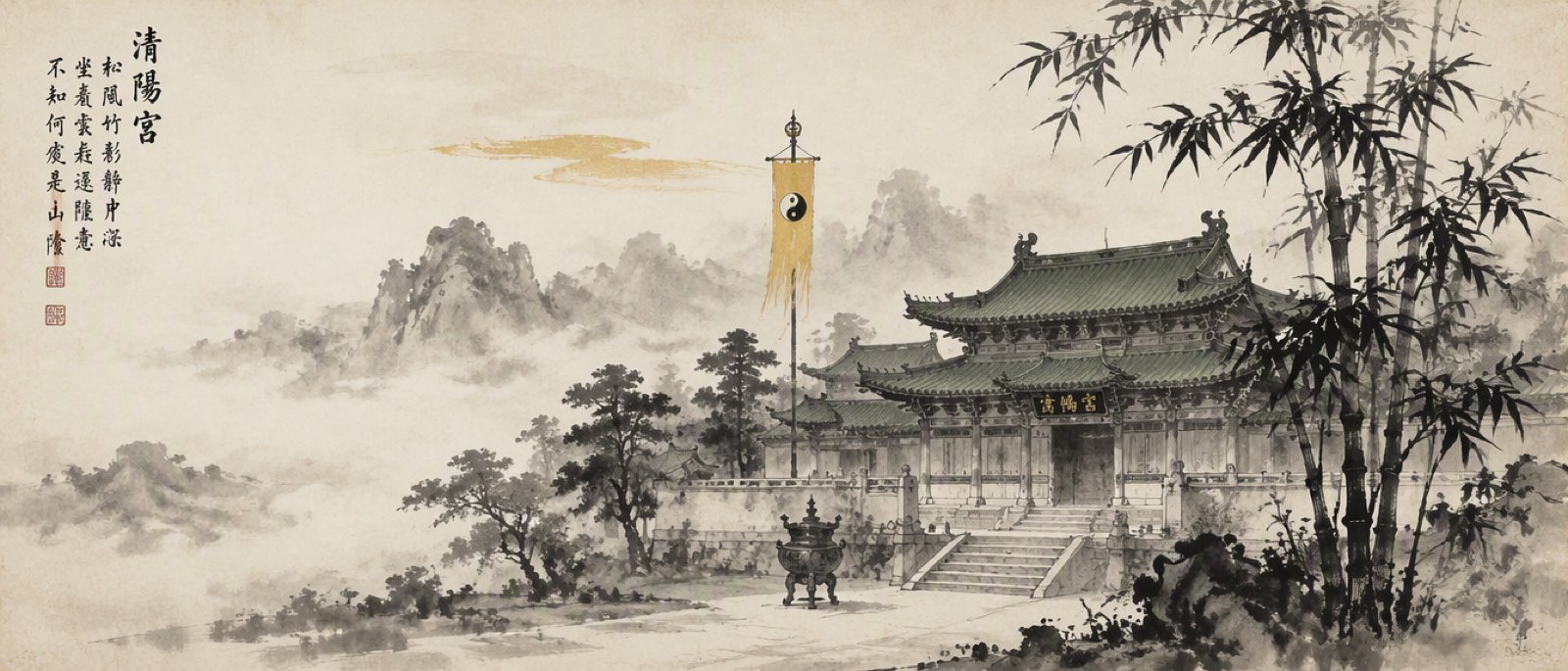
One of the largest and oldest Taoist temples in southwest China, and a major surviving monument of Taoist practice in Chengdu. Its founding legend ties it directly to Laozi: he is said to have promised Yin Xi, the gatekeeper who first received the Daodejing, that the two would meet again at a shop selling green rams in Chengdu — a promise that gave the temple its name. Much of the current complex dates to Qing-dynasty reconstruction after Sichuan's temples suffered widespread destruction during the mid-17th-century upheavals surrounding Zhang Xianzhong's occupation of the province; the temple's distinctive octagonal Bagua Ting (Eight Trigrams Pavilion) dates to the late Qing expansion of the site.
Sacred narrative
The promised reunion at the green ram shop
The temple's founding legend extends the story of Laozi and Yin Xi past the dictation of the Daodejing at the western pass: before departing, Laozi is said to have told Yin Xi that if he wished to see him again, he should look for him in Chengdu, at a shop selling green rams, on a specified future date. When Yin Xi eventually made the journey and found such a shop, he is said to have encountered Laozi there in a transformed, radiant appearance, confirming both the reality of his earlier teaching and the ongoing, cyclical nature of the sage's presence in the world. The legend gave the site its name and its enduring association with Laozi, and the temple's bronze ram statues flanking its main hall remain a popular object of pilgrim devotion, touched for good fortune.
History
Founded Recorded from the Tang dynasty; largely rebuilt under Qing-dynasty patronage (Kangxi era onward) after mid-17th-century destruction.
Key figures
- Laozi (founding legend)
- Yin Xi (founding legend)
Major events
- Tang dynasty: earliest textual records of a temple on the site
- Mid-17th century: widespread destruction of Sichuan temples during the upheavals of the Ming-Qing transition
- Qing dynasty (Kangxi era onward): major reconstruction, followed by late-Qing expansion including the Bagua Ting
Today
The site as it currently stands.
Central Chengdu, accessible by metro; open daily with an entrance fee
Year-round; spring temple fair around the Lantern Festival draws especially large crowds
Chengdu, Sichuan
Resident Quanzhen monastic community; active center of the Sichuan Taoist Association
busy
Back to the geography
Return to Sacred sites, or read the concepts practised there.